

Kintsugi: where broken things learn to shine
A Japanese art that doesn’t erase damage, but asks it to become part of the story

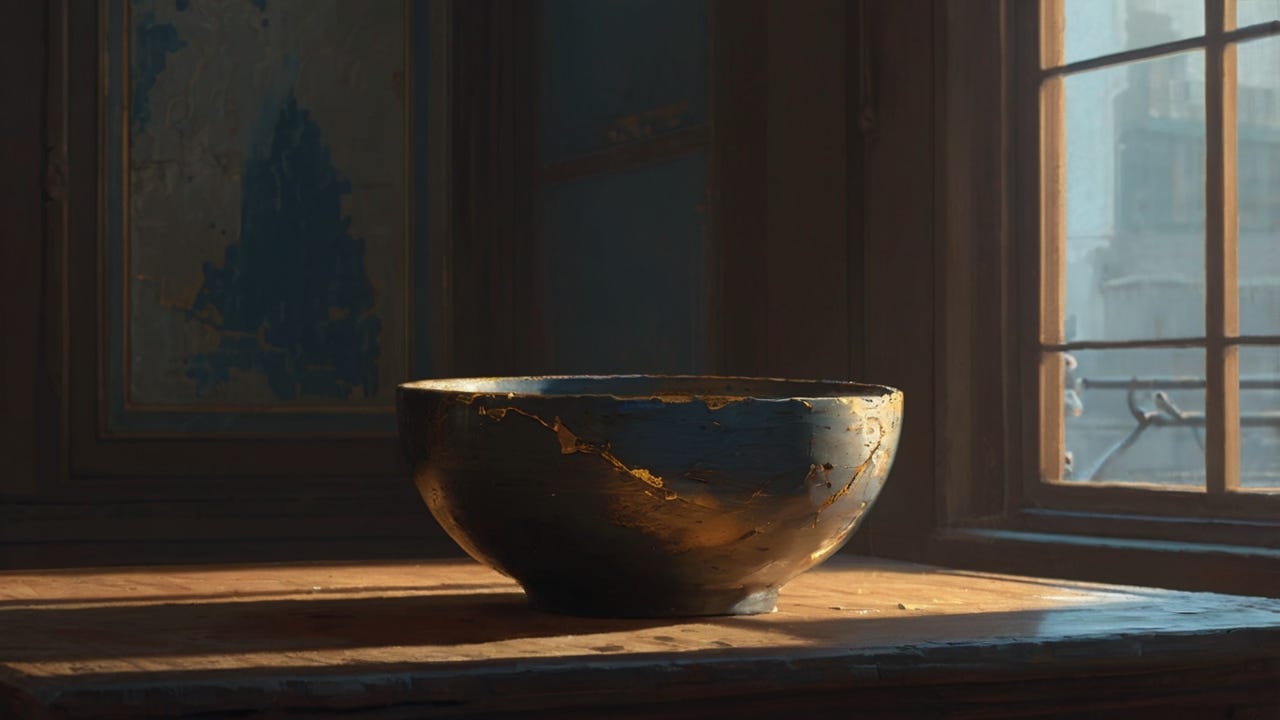
In a world obsessed with smoothness, there is something unsettling about Kintsugi.
It does not restore objects to how they once were.
It does not hide fractures or pretend nothing happened.
It does not chase perfection.
Instead, it pauses at the moment of breakage. And stays there.
Kintsugi, often translated as “golden joinery” (金継ぎ), is the Japanese art of repairing broken ceramics with lacquer mixed with powdered gold. The cracks are not concealed. They are illuminated. The damage becomes visible, deliberate, and strangely luminous.
A bowl breaks.
It returns — changed.
Not newer.
Not flawless.
But carrying its history in gold.
Repair once became an aesthetic.
Kintsugi emerged in Japan during the late 15th century, a period shaped by ritual, restraint, and refinement. This was the Muromachi era. It was a time when aesthetics were inseparable from daily life. Especially within tea culture.
Legend often points to the shogun Ashikaga Yoshimasa. A patron of the arts with a refined eye. When his cherished Chinese tea bowl cracked, he sent it back to China for repair. It returned mended with crude metal staples — functional, but visually jarring.
The repair worked.
But it violated something deeper.
What followed was not a philosophical manifesto, but a practical question with aesthetic consequences:
Can something be repaired without losing its dignity?
Japanese craftsmen responded not by hiding the damage, but by reframing it. They used urushi lacquer, dusted with gold, silver, or platinum, to bind fragments together. The repair became intentional. The break became part of the object’s identity.
This was not about decoration.
It was about continuity.
In Kintsugi, gold is not used to impress.
It does not dominate the object.
It does not distract from its form.
Instead, it traces the moment where the object failed… and survived.
Gold, in Japanese aesthetics, has long carried symbolic weight. It reflects light without shouting. It resists decay. It endures. In Kintsugi, gold acts less like embellishment and more like a witness.
It marks where something broke. And where human hands chose not to discard it.
The crack is no longer a flaw.
It is a record.
To understand Kintsugi, one must understand the world it lived in.
Tea bowls were not casual objects. They were handled slowly, deliberately, often in silence. They absorbed the gestures of those who used them. Chips and cracks were not unusual. They were expected, even accepted.
Discarding such an object would have meant discarding its accumulated presence.
Kintsugi allowed a bowl to remain in use. To continue participating in ritual. To age forward rather than be replaced.
This is where meaning quietly enters. Not as metaphor, but as practice.
Kintsugi is often associated with Wabi-Sabi.
Wabi-sabi is the Japanese aesthetic that finds beauty in impermanence, asymmetry, and incompletion.
But wabi-sabi is not an idea you adopt.
It is a way of seeing.
A chipped rim.
A faded glaze.
A surface shaped by time rather than design.
Where wabi-sabi appreciates imperfection, Kintsugi responds to it. It does not merely accept damage. It works with it.
The repair is visible.
The history is honored.
Nothing is erased.
Today, Kintsugi travels far beyond Japan.
It appears in therapy metaphors, design blogs, and social media quotes. Some of this attention simplifies it. But the resonance itself is telling.
We live in a culture of upgrades and replacements. When something breaks, we discard it. When something falters, we hide it.
Kintsugi proposes a different rhythm.
It asks:
What if repair mattered more than replacement?
What if traces of damage were not embarrassing?
What if continuity held more value than novelty?
These are not self-help questions.
They are cultural ones.
And Kintsugi already goes beyond ceramics.
Modern artists have returned to Kintsugi not to romanticize it, but to extend its logic.
Yee Sookyung’s “Translated Vase” reassembles discarded ceramic shards into monumental sculptures, binding fragments with gold leaf. The result is not restoration, but transformation — objects that could never have existed before they broke.
Victor Solomon, in his Literally Balling series, repairs shattered basketball backboards with gold, merging athletic rupture with ritual repair.
Rachel Sussman’s “Sidewalk Kintsukuroi” fills cracks in urban pavement with gold, momentarily turning infrastructure failure into something contemplative.
In each case, Kintsugi becomes less a technique and more a lens.
Architects speak of visible mending — leaving repairs exposed rather than concealed.
Designers celebrate seams, joints, and material honesty.
Fashion houses embrace patchwork, stitching, layering.
These are not direct imitations.
They are philosophical descendants.
They suggest a shift: from perfection as polish, toward perfection as coherence.
What Kintsugi does (and does not) teach us
Kintsugi does not promise healing.
It does not insist that everything happens for a reason.
It does not glamorize suffering.
What it offers is quieter.
It shows that breakage is not the end of usefulness.
That repair can be dignified.
That history can remain visible without becoming a burden.
A Kintsugi bowl does not forget its fracture.
It learns how to hold tea again.
Gold is not the point.
And this matters.
Too often, Kintsugi is reduced to gold as symbolism. As if the lesson were simply “add value to your wounds.” That misses the craft entirely.
The real act lies in:
taking time
choosing not to discard
repairing by hand
accepting change
Gold is simply the material that makes this decision visible.
Kintsugi belongs to a worldview where objects are allowed to age, fail, and continue.
In that sense, it offers not a lesson. But a reminder.
That what breaks does not need to disappear.
That repair can be an act of respect.
That continuity is sometimes more beautiful than perfection.
And perhaps that is why, centuries later, a bowl mended with gold still holds our gaze.
Not because it is flawless.
But because it stayed.
Culture only stays alive when shared. So, why not pass this on to a fellow explorer?
The same cultural wisdom explored here inspires my mythic worldbuilding project. If you’re curious, you can see how these insights can take shape in imagined worlds.
Savoring the passing of time...